
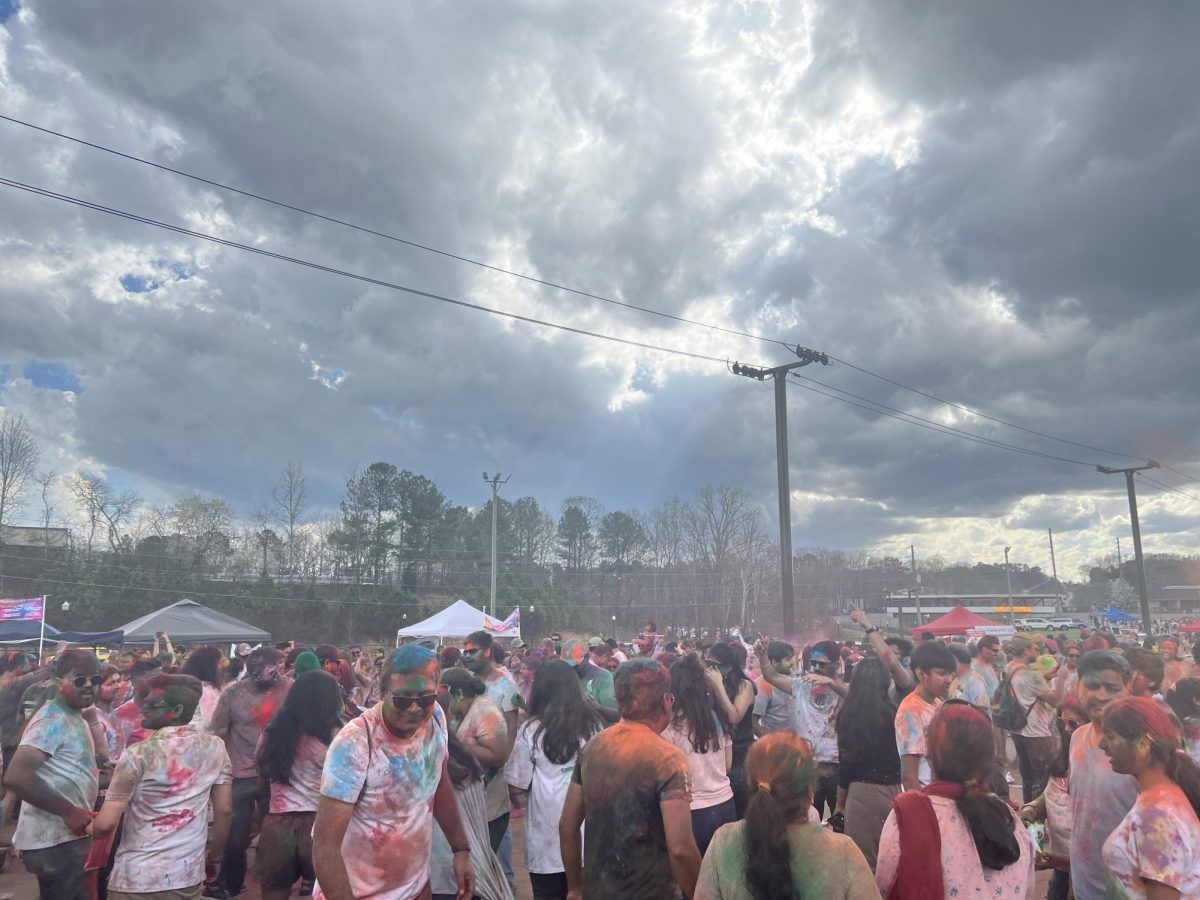
Imagine a day filled with throwing colorful powder at each other and music. Sounds like something I did in elementary school on field day. Now, can you believe that there is a festival out there where once a year people gather up to throw colors at each other? It exists!
Holi is a Hindu festival which is celebrated in March every year to welcome spring, signifying the triumph of good over evil and to celebrate the love of Hindu deities Radha and Krishna. The exact date of the festival varies each year according to the Hindu calendar but mostly appears in March. In some places, Holi is celebrated for multiple days, whereas others only spend an afternoon for this festival. Typically, when celebrating Holi people wear white clothing and throw colored powder, which is called ghulal, or colored water on each other.
Holi’s origin is deeply tied with Hindu mythology and is enriched with various stories. One story regarding this festival is about a famous legend of an arrogant demon king, Hiranyakashipu, and his son Prahlad. Prahlad defies his father by becoming a devotee of Vishnu, who is an important Hindu deity. The king becomes furious and decides to kill Prahlad by conspiring with his sister to burn him alive. However, Prahlad is unharmed, whereas Hiranyakshipu’s sister perishes within the flames. Prahlad’s survival leads to the celebration of Holi to mark the victory of good over evil.
Another mythological story revolves around Radha and Krisha. Krishna and Radha are renowned Hindu Deities known for their everlasting love. According to Hindu mythology, Krishna’s skin was stained blue due to a demon. So, he vents to his mother Yashoda, concerned that Radha would be disgusted by his abnormal appearance. Yadhoda jokingly suggests that he smear color on Radha as well. Krishna follows his mother’s advice and upon doing so Radha falls completely in love with him.
Finally, another major story tied to Holi is the story of Lord Shiva and Kaamadeva. When Lord Shiva’s wife, Sati, died, he became furious and sorrowful. He renounced his duties as a god and went into deep meditation. Parvati, who was enamored with Lord Shiva since her childhood, decided to go into deep meditation in order to acquire him as her husband. The rest of the deities decided to approach Lord Kaamadeva, the god of love and passion, to bring Shiva back to his original self by having him fall in love with Parvati. Lord Kaamadeva shot his arrow at Lord Shiva, aware of all potential consequences of disrupting his meditations. As planned, Lord Shiva fell in love with Parvati the moment the arrow met; however, Shiva became extremely angry since his meditation was broken causing him to open his third eye–disintegrating Lord Kaamadeva to ashes. Kaamadeva’s wife, Rati, pleaded Lord Shiva to revive her husband and explained how it was planned by the other deities. Lord Shiva declares Kaamadeva will be revived but without a body and will be invisible to everyone except his wife. To remember Lord Kaamadeva’s sacrifice, Lord Shiva declared the celebration of Holi.
All of these stories are wonderful, each one being a unique tale filled with love and positivity. There are various events across Georgia to celebrate this amazing holiday. One of them was held by Sewa International USA on March 7 from 11 a.m. to 4 p.m. at Cumming Fairgrounds. The 19th festival of colors held by the organization was amazing. Everyone walked in there looking perfect and came out drenched with colors. Music filled the atmosphere as people threw colored powder at each other. There were various dance performances as well as classic Indian food available for people to buy.
Holi’s exact origins are unknown, but each place has their own stories that make the festival so much more beautiful. Spreading love and marking the success of good over evil through colors is a wonderful ideology and should definitely be celebrated by everyone.
